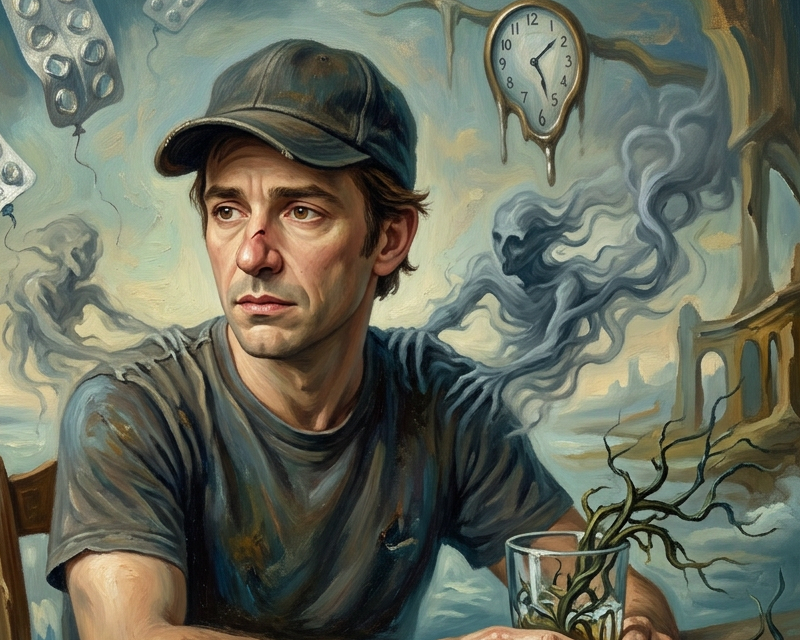

No need to chase light, strength or love, as you yourself are already them.
— From a soul as glowing as yours
I used to be obsessed with finding a once-for-all solution to my problems. I dreamed of a perfect answer, like an undying light illuminating a new path directly towards my ideal life. If my problem were a math equation, the light would be the only correct answer. The problem shouldn’t be just “partially solved” or “mostly solved”; it had to be “completely solved”. If not, then it must be me not having found the “rightest” answer yet.
Then a recent experience began to shake this belief.
Building an Exercise Habit – Motives, Plan, and Progress:
I wasn’t a fan of running in the past. A few years ago, I tried to force myself to run every morning, but gave up after 3 days because I disliked the panting, the tight chest, and the cutting pain in my throat.
I tended to feel low, anxious and lacking energy periodically. About 2 months ago, I came across a research study (Schuch et al., 2023), suggesting that 45-min outdoor running sessions (10 minutes of warm-up and 30 minutes of jogging) 2 to 3 times weekly for 16 weeks can be as effective as anti-depressants in treating depression and anxiety, while also providing significantly greater benefits in physical health.
I decided to try building a running habit, not exactly the same as what was described in the study, but more tailored to my convenience and preferences. My goal was to incorporate exercise into my daily life without relying much on my willpower, so I applied a strategy frequently mentioned in Cognitive Behavioural Therapy (CBT) — Start Small.
I set up an easy plan: Every time I went outside and came back, I would head straight to the condo gym and run before going home. It could be as little as 1 minute. On the 1st day, I ran for 6 minutes, and the 2nd day, 6 minutes again. In the 2nd week, I could go beyond 10 or even 20 minutes.
Once I started, the momentum naturally took over and kept me going. Everything seemed on the right track, and I even imagined myself running a marathon one or two years later, proud to claim that starting small is the key to build any habit, hobby, or lifestyle you want for yourself. As long as you begin small, you can always achieve big.
But the reality wasn’t what I expected.
Challenges Beyond The “Magic” Solution:
As the novelty faded, I started feeling bored on the treadmill; my mind wandered, and it became harder to feel peace. I chose to run for a shorter time even when my body could go more. If I stopped running 2 or 3 days in a row, more willpower was needed to resume it afterwards. Moreover, my progress slowed; for some days, even running for the same amount of time as before became difficult.
My Toolkit of Trials and Errors:
I started thinking about ways to deal with these challenges.
Combatting Boredom: I first tried listening to music, but then I found it caused discomfort to my ears. I turned to meditation, scanning my body from head to toe, but that couldn’t kill much time. Next, I tried change my running speed — When I felt bored, I ran faster, and my focus automatically shifted to my body due to the physical intensity. I didn’t even have the mental capacity to wander. When I felt tired, I slowed down, and speeded up again when boredom returned. At times, I ran for a few minutes, then stopped, sitting on the floor, where I felt a sense of peace feeling my body slowly calmed down, then returned to the treadmill when ready.
Maintaining Motivation: Since I wrote in a notebook to track how long I exercised each day, I made sure not to skip 2 consecutive days. I lowered my expectations and allowed myself to run for a shorter time, depending on my physical and mental state.
Takeaways:
I realized that building a habit requires not only the strategy, but also continuous flexibility and creativity. Starting small isn’t a smooth path towards the destination; instead, it’s a doorway leading to a bumpy and winding path, designed uniquely for me, where I navigate by leaping over dips and sidestepping puddles.
I start to enjoy this process — it makes me the creator, taking charge to make changes and overcome barriers. It’s a journey of reclaiming my power, through which I experience my strength and creativity again and again. I start to enjoy mistakes and failures, for they make the path uniquely mine. Isn’t this more fun than getting a once-for-all solution from someone else and passively walk alongside a plain path, a path that’s not even belong to me?
The same idea applies to everywhere else. I wished my meds could take away all my depression and anxiety, I wished a professional could solve all my problems, I wished a book would clarify all my confusion…etc. But by pinning my hope on all these things, I subconsciously handed out my power and robbed myself of the opportunities to explore, create, experiment, and discover. I placed myself in a victim position, waiting to be saved.
If you’ve read this far, I hope my experience resonates a little with you. Please always remember that you are the answer itself no matter what the problem is. All the strategies, advice, or lessons were a temporary light, guiding you through your darkest moments, and ultimately faded away. You, however, are the everlasting light that illuminates your own journey.
It can be hard to remember this during your dark times. We understand and that’s why we are here. Come to our groups, and we’ll remind you how glowing you are.
Reference:
Verhoeven, J. E., Han, L. K. M., Lever-van Milligen, B. A., Hu, M. X., Révész, D., Hoogendoorn, A. W., Batelaan, N. M., van Schaik, D. J. F., van Balkom, A. J. L. M., van Oppen, P., & Penninx, B. W. J. H. (2023). Antidepressants or running therapy: Comparing effects on mental and physical health in patients with depression and anxiety disorders. Journal of Affective Disorders, 329, 19–29. https://doi.org/10.1016/j.jad.2023.02.064